Tuesday, 28 June 2011

The Luxembourg Palace


The Luxembourg Palace
His stay with Audran had a profound influence on the art of Watteau. There were no gardens of the Luxembourg in those days, and the park attached to the royal palace was full of wild and natural beauty which appealed to the young artist, and drew forth his powers as a landscape-painter. It was here that he discovered and learnt to paint those clumps of trees which form the background to the figures of his idylls and pastorals.
Inspired thus by the externals of the palace, Watteau was also profoundly moved by what was within, the picture-gallery containing the series of great paintings by Rubens which illustrated the life of Marie de' Medici.

The Felicity of the Regency of Marie de' Medici this is the final painting in the cycle.

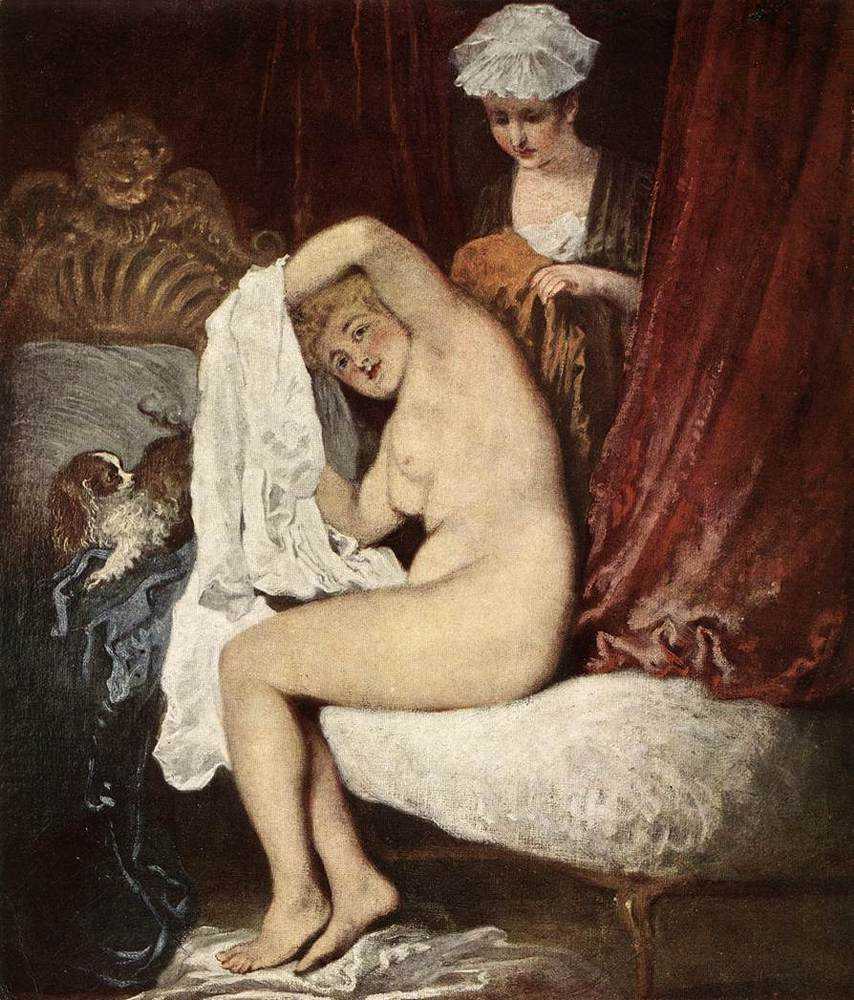
Watteau viewed these spirited paintings again and again ; he copied them with zest, and became so saturated with Rubens that eventually he was able to deflect his fellow-countrymen from Italian ideals and revivify French painting with the vigorous realism of Rubens. His worship of the great Fleming, to whom he felt himself related by ties of race as well as artistic sympathy, never degenerated into servile imitation. Camille Mauclair a French critic said " by means of a gradually widening realism," Watteau " arrived at the point of preserving in his small canvases all Rubens' admirable breadth, while achieving a masterly originality of grouping." A superb example of Watteau's powers in this respect is his " Lady at her Toilet " in the Wallace Collection.

Lady at her Toilet
Watteau experimented with glazes that have darkened with time, unfortunately the cleaning attempt conducted by the Wallace Collection means that this painting once thought of as the most beautiful ever painted by Watteau now looks grubby and neglected, indeed a sorry sight.

Sunday, 26 June 2011

The Young Watteau

Antoine Watteau although thought of as essentially and characteristically French, he was born in 1683 at Valenciennes, near the Franco-Flemish frontier only six years after it ceased to be part of Flanders thus giving him primarily a Flemish heritage.
It was this weakling, whose frail form was prematurely ravaged by consumption, who some say founded the greatest and strongest of all the modern schools of painting.
His father, a plowman and carpenter, was in poor circumstances, and the boy is said to have had an unhappy childhood. Watteau senior bore the reputation of being a hard man, and wanted his son to become a tiler and hewer like himself so when young Antoine obtained permission to work in the studio of a local artist called Guerin, who was painter to the municipality of Valenciennes, the father refused to pay the expenses of his son's education.
After the death of Guerin in 1702, Antoine Watteau, then aged nineteen, ran away to Paris with a scene-painter called Metayer. But when they had arrived in Paris, this man soon abandoned his young companion when he had no more work to give him, and henceforward Watteau, already in delicate health and disowned by his father, was alone in Paris, without money, clothes, or resources of any kind. In desperate poverty he at last found employment in a wretched workshop where cheap religious pictures were produced by the dozen, to be retailed by country shopkeepers. Nowadays printing has saved artists from this kind of drudgery, but in the early eighteenth century even the lowest-priced coloured card had to be done by hand. What was required of Watteau and his fellow-labourers was rapidity of execution in making copies of popular subjects, and for this work he was payed a small pittance and one daily meal of soup !
Yet even in this miserable trade Watteau managed to distinguish himself, and was entrusted with the reproduction of a " St. Nicholas " that was in great demand. One day the mistress of the workshop forgot to give Watteau the " St. Nicholas " to copy, and remembering her oversight later in the day, she climbed up to Watteau's attic to scold him for idling. After she had worked herself up into a passion, Watteau amazed her by showing her his day's work, a perfect St. Nicholas, which he had completely finished from memory.

St. Nicholas
 Through all this period of drudgery and semi-starvation, Watteau never despaired, and snatched every opportunity to improve his art, drawing from Nature at night and during his rare holidays and leisure moments. Then by a happy chance he made the acquaintance of the decorative artist Claude Gillot, who, after seeing Watteau's drawings, invited the young man to live with him.
Rescued from his miserable factory, Watteau worked with enthusiasm at the ornamental painting of his new friend, who was then chiefly engaged in representing scenes from Italian comedy.
Claude Gillot scene from “Master Andrews’s Tomb”


Watteau, who in his poverty and ill-health worshiped elegance and all the graces of life, soon rivaled and surpassed his tutor in painting slim Harlequins, simple Pierrots, dainty Columbines, and other well-defined characters of Italian comedy ; and it may be that Gillot grew jealous of his protege. After a period of warm friendship, the two artists parted on bad terms, and though Watteau in after-life never ceased to praise Gillot's pictures, he kept silent about the man, and would never answer when questioned about the breach between them. Gillot, on the other hand, tacitly acknowledged his pupil's superiority, for some time after the quarrel he abandoned painting and devoted himself to etching.
When Watteau left Gillot, his fellow-assistant, Nicolas Lancret (1690- 1743), who afterwards became his pupil, left with him, and both young men found employment with Claude Audran, a painter of ornaments, who was also a guardian of the Luxembourg Palace.

 Nicolas Lancret, The Luncheon Party.

Sunday, 19 June 2011

The build up to Watteau.

Thought I would revisit Watteau (1684–1721) and explore some of his life and times. Most of what hopefully follows will have been gleaned from "A History of Western art" and William Orpen’s book "An Outline of Art" plus vigorous web browsing!
The seventeenth and succeeding century was a time of turmoil throughout Europe with the waging of wars and signing of treaties the map and political alliances changed continually.
Art flourishing in Holland with the rise of the Dutch Republic, but it was not until 1648 that Spain finally recognizing Dutch independence.
By this time in France two streams of tradition, one democratic and derived from the Low Countries, the other aristocratic and inspired by Italy was developing. These two French schools of painting, which mirror respectively the life of the nobles and the life of the peasants, gave warning of that sharp division of the classes which led to the French Revolution.
After the hundred years war(1337-1453) French art was no longer the church art of the earlier centuries. The French painters were still almost wholly under the influence first of Flanders and then of Italy. Jean Clouet was appointed Court Painter to King Francois I in 1516 he was the son of a Brussels artist, and both he and his son Francois Clouet (c. 1510-72), who succeeded him, carried on a Flemish tradition.


Portrait of an Unknown Man By Jean Clouet


Portrait of an Unknown Man By Francois Clouet

Though the drawing of the Clouets has been held to be characteristic of France, the style of both artists was close to that of their contemporary Holbein.

Holbein Head of a Woman

Flemish again in character was the work of the three brothers Le Nain, Antoine and Louis, who both died in 1648, and Matthieu, died 1667—who came from Laon and settled in Paris. The gentle seriousness of their paintings of rustics foreshadows the peasant masterpieces of Jean Francois Millet. They are the ancestors of the democratic painters of France.

Louis Le Nain- Happy Family- 1642


Tuesday, 14 June 2011

Fruits de mer

Haven’t posted to the Blog for some time as I’ve been away sailing in France. Every two years a sailing event "Semaine du Golfe du Morbihan" takes place in southern Brittany.
The event is for Traditional working and classic sailing boats, this year there was a record entry of 1,500 boats from all over Europe but mainly from France. The French have preserved their maritime history very well by maintaining the skills needed to restore and keep sailing the traditional work boats of the various regions.
Though boats are not usually thought of as art some definitely deserve to be “LA CANCALAISE”is one such boat. She is a replica of "THE PEARL" a lugger from Cancale of 1905. Pearl was a typical boat from the Bay of Mont Saint Michel.

La Cancalaise under full sail, topsails and topgallants!

When John Singer Sargent was 22 (1877) he painted “Oyster Gatherers of Cancale” La Cancalaise would have been the type of boats that the men of Cancale had set off in to fish the grand banks during the summer, thus leaving the woman to fend for themselves by gathering oysters.

Sargent spent the summer painting in Cancale and getting to know the Cancalaise people who he admired for their tenacity in earning a living from the sea. When the men arrived home at the end of the season there might be plenty of money if the fishing had been successful, but a lot of that money would have to go back into the boats for next year. Consequently the women’s earnings from the oysters was very important to the families and Sargent has captured that feeling of community amongst the women.

Sunday, 8 May 2011

Trois Crayon and Papers

More on the use of Trois Crayon as I said in the earlier post the paper used can be a mid-tone grey, blue, or tan. The paper can either be purchased, most paper companies produce toned papers such as Fabriano Tiziano or Ingres Paper. Canson Mi-teintes is another range of suitable paper.

It is also possible to use a watercolour wash applied to any good quality drawing paper.

Yet another ploy is to use Acrylic Colours to tone Acrylic Gesso which can then be used to paint over old drawings you are not happy with, this gives you a new drawing surface that takes charcoal and chalk well and you are not restricted to the colours the manufacturers supply.

This is a drawing done from life at the Tenby portrait group using a watercolour wash on cheep drawing paper, charcoal, white chalk and lump Sanguine.


There is so much to learn from any Hans Holbein drawing so here is Sir Thomas Elyot for you to peruse.
Sir Thomas was a supporter of the education of women, a radical humanists idea in sixteenth century England.

Saturday, 7 May 2011

Thoughts with the blood one.

Recently I posted a Trois Crayon drawing of Helen of Wales, Trois Crayon is a traditional drawing technique using three coloured chalks: red (sanguine), black, and white. The paper used is a mid-tone and can be grey, blue, or tan. The temperature of the sanguine is very important and must be matched to the cool or warm colour of the paper. Conte make three distinct sanguine’s so you can match them to the plethora of papers available. Also Cornelissen sell genuine lump sanguine.
When trois crayon is mentioned usually the French painter Antoine Watteau comes to mind. He loved drawing with sanguine thinking of his drawings as “pensees a la sanguine” = thoughts with the blood one.


Open sessions painting from the life


Helen again this time in oil. We are very lucky to have a choice of both portrait and life drawing groups locally. This is from the Narberth portrait group. The sessions are run as open sessions and only charge enough to cover expenses of model and venue hire.

Wednesday, 4 May 2011

Helen of Wales.

Jumping forward to the present, here is my current effort which shows my understanding at the moment.


Helen of Wales.


This was done from life with the Tenby portrait group and is my exploration of Trois Crayon using sanguine, white and sepia Conte crayons on a blue gray paper. The big problem with the drawing is the perspective of the face which I didn’t notice until it was to late. A blank piece of paper is always so exciting as there is always the possibility that things will turn out well!

The Venus of Willendorf

Since the discovery of the Altamira Caves in 1880, older art has been found. I believe the oldest recorded art at present is a cupule in the Auditorium Cave at Bhimbetka, Madhya Pradesh, India. It dates from (290,000-700,000 BCE).


The Venus of Willendorf is the oldest example of the human form and dates from 24,000-22,000 BCE. She was found in 1908 above the Danube river near the town of Willendorf in Austria by archaeologist Josef Szombathy.


Only 43/8" high. she rivals anything in modern art.

In our age when images of art are so readily available in galleries, museums, books and the Internet, it’s hard for us to imagine how these earliest artists thought and worked to produced the first art with no precedence.

Tuesday, 3 May 2011

Altamira Caves

A Journey into Art so where should I begin with this first post?
The Art of Prehistoric Man seems like a good starting place, it might even give us some idea of why we make art and what it’s all about.
The creation of things for use is easy to understand: tools, clothing, shelter and weapons all had a utilitarian purpose for early man as they still do today. But why would we decorate things? Amazingly early in history we find decoration: pattern being added to pots and weapons and clothes, and later to shelters. This decoration seems to serve no material or biological purpose. It does not make the shelter more secure or keep the body warmer or safe from harm. Its actual creation means effort and patience for a postponed mental pleasure. Is that pleasure anticipated while the work is in progress? Or is the pleasure in the process of making? It's a strange and apparently meaningless undertaking that throws a spotlight on the nature of Man.


The illustrations I have chosen for this first post are from the Altamira Caves near Santander in Northern Spain.
These caves were discovered in the late nineteenth century by a huntsman or perhaps it would be more correct to say that the fox he was chasing did by taking refuge there, and that the huntsman's dog had followed the fox, and the huntsman had followed the dog! He in turn told Santavola, a local archaeologist who went to the cave to look for any clues of occupation by prehistoric Man. Suddenly his daughter, going deeper into the cave, pointed to the flattish ceiling of the great cavern and cried :
" Look, father ; bulls ! "


Dating from 15,000 BCE (the Upper Palaeolithic period) they were the first prehistoric cave paintings to be discovered. Since then much older paintings and art have been discovered.
Related Posts Plugin for WordPress, Blogger...